
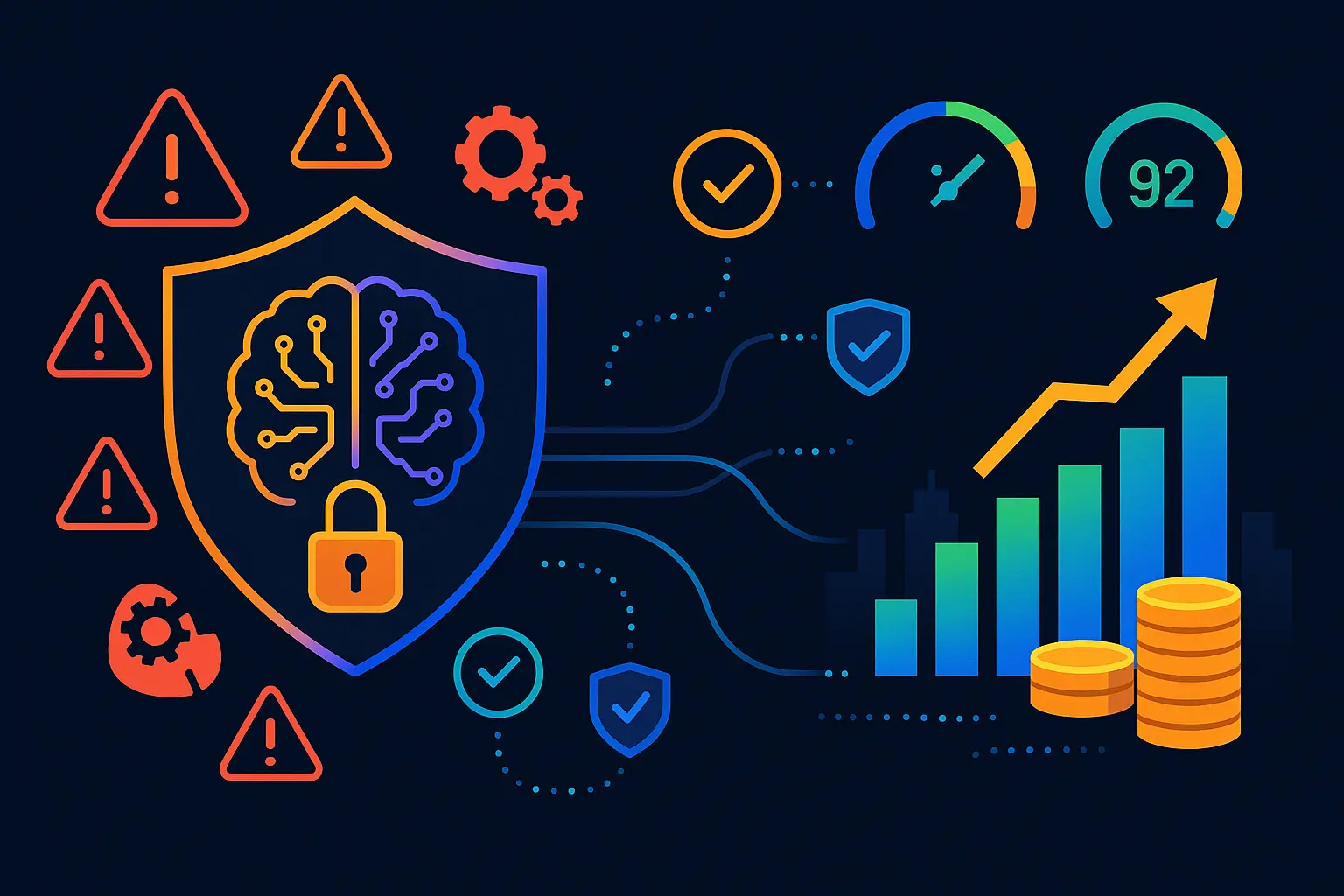
AI Trust, Risk and Security Management (TRiSM) is about more than checklists and slowing things down. It’s the practical work of keeping AI systems safe, useful and accountable while letting the business move fast. In plain terms: it’s about governing models, the data that feeds them, and what they do in the world so you don’t trade short‑term speed for long‑term damage.
Why this matters now: models are becoming more powerful and more embedded in core workflows, agentic systems can act without constant human supervision, and rules from regulators and customers are arriving quickly. That combination raises both the upside and the exposure for any company using AI. TRiSM isn’t bureaucracy — it’s the way to make AI dependable enough to unlock measurable value.
This article takes a practical view. We’ll define what TRiSM really covers (governance, data and IP protection, ModelOps, runtime enforcement), show the control patterns that actually work in production, and explain how those controls tie to things CFOs and investors care about: downside protection, audit readiness and real upside in retention, revenue and deal momentum.
What you’ll get in the next sections:
- A plain‑English definition of TRiSM and what it is not
- The TRiSM stack you can run in production — from inventories to AI gateways
- Concrete metrics and control blueprints for high‑ROI use cases
- A practical 90‑day rollout plan to move from discovery to evidence‑ready controls
Read on if you want to move past vague “AI safety” talk toward controls that reduce risk and create measurable enterprise value — without killing innovation.
What AI TRiSM means—beyond buzzwords
Plain‑English definition and scope: governing models, data, and runtime behavior so AI stays safe, useful, and accountable
AI TRiSM is the set of practices, roles and technical controls that ensure AI systems deliver the business value you expect while staying within acceptable risk boundaries. It covers three connected domains: the models and algorithms themselves, the data they use, and the behavior of AI systems when they run in production.
In practice that means a few simple things: maintain a living inventory of models and their lineage; manage and classify data sources; define who is accountable for which risks; bake evaluation and monitoring into the delivery pipeline; and enforce safety and policy checks at runtime. TRiSM treats these activities as operational capabilities—not one‑off projects—so safety, usefulness and auditability are repeatable outcomes.
Why now: generative AI, agentic systems, and fast‑moving regulations raise both impact and exposure
Recent advances in capability and scale have made AI more powerful and more embedded in business processes. Systems that can generate language, take multi‑step actions, or autonomously interact with other services increase both potential upside and potential harm. That amplifies the consequences of errors, bias, data leakage or unintended automation.
At the same time, stakeholders—customers, partners, regulators and buyers—expect clear evidence that those systems are governed. This combination of technical capability and external scrutiny means organisations must move from ad‑hoc experimentation to disciplined, measurable management of AI risk and security.
What TRiSM is not: checklists without outcomes or shipping delays disguised as “governance”
TRiSM is not a paper exercise or a set of box‑ticking activities that slows product teams. Stopping models from shipping while you draft a 100‑page policy is not governance—it’s paralysis. Effective TRiSM is outcome‑oriented: it reduces real business risk, enables faster and safer deployment, and produces evidence that decision‑makers can rely on.
Nor is TRiSM purely a security or compliance silo. It requires product, engineering, security, legal and business leaders to share clear risk appetites, decision rights and metrics. Good TRiSM makes teams faster and more confident, because it replaces uncertainty with repeatable controls, automated checks and a playbook for incidents.
With the concept defined and common misconceptions cleared up, the next part will translate these principles into the concrete layers, tools and runbooks that let organisations operate trustworthy AI at scale.
The AI TRiSM stack that works in production
Governance: model inventory, risk register, human‑in‑the‑loop, decision rights
Start with clarity: an authoritative model inventory that records purpose, data sources, owners, versions and approved use cases. Pair that with a risk register that maps model risk to business impact, regulatory exposure and mitigation owners.
Operational governance assigns decision rights (who approves production, who can override outputs) and embeds human‑in‑the‑loop checkpoints where decisions are high‑impact or legally sensitive. Make these responsibilities explicit in role descriptions and release gates so teams know when automation is allowed and when human review is mandatory.
Data and IP protection: ISO 27002, SOC 2, NIST CSF 2.0; least‑privilege, DLP, encryption, secrets hygiene
“Security frameworks matter in dollars and deals: the average cost of a data breach in 2023 was $4.24M and GDPR fines can reach up to 4% of annual revenue — while implementation of NIST/ISO/SOC controls not only reduces breach risk but has demonstrable commercial upside (eg. a NIST-backed supplier won a $59.4M DoD contract despite a lower-priced rival).” Portfolio Company Exit Preparation Technologies to Enhance Valuation — D-LAB research
Translate frameworks into concrete controls for AI: least‑privilege access to training and inference data, robust data loss prevention for logs and outputs, field‑level encryption for sensitive attributes, and tight secrets hygiene for API keys and model credentials. Treat model weights and training corpora as mission‑critical IP—track their provenance, restrict exports, and include them in supplier due diligence.
ModelOps and explainability: evaluations, drift and bias monitoring, lineage and versioning
ModelOps operationalises the lifecycle: reproducible training pipelines, immutable model artifacts, automated CI for evaluation, and documented lineage linking datasets, code, and configuration to deployed artifacts. Version every model and dataset so you can roll back or audit a decision pathway.
Explainability is practical: baseline tests, model cards, and interpretability reports for stakeholders. Run continuous drift and bias monitoring with alerts tied to impact thresholds (e.g., customer segmentation shifts, degradation in fairness metrics). Pair automated signals with human review workflows so flagged issues are triaged and remediated fast.
Runtime inspection and enforcement: AI gateways, prompt‑injection defenses, output filtering, policy checks
Insert a runtime control plane between users and models: an AI gateway that enforces policies, applies input sanitisation, and records rich telemetry. Gateways also centralise authorization, rate limits, and routing to approved models or safe fallbacks.
Defend against prompt injection and data exfiltration with context isolation, allowlists for retrieval sources, and strict secrets separation. Apply layered output controls — policy checks, content moderation, confidence‑based gating and human escalation — so unsafe or ambiguous outputs never reach downstream systems without appropriate review.
Mandatory features: AI catalog, data mapping, continuous assurance/evaluation, runtime enforcement
Production TRiSM converges on a handful of non‑negotiables: an AI catalog (searchable inventory of models, owners and SLAs), end‑to‑end data mapping (who owns each dataset, lineage and retention), continuous assurance (automated tests, audits and evidence packs) and runtime enforcement (gateways, filters, escalation paths).
Make these capabilities composable and measurable: instrument every control with telemetry, define SLAs for mitigation actions, and keep auditor‑ready records so security, legal and finance can validate risk posture without interrupting product velocity.
With the stack described and controls mapped to both engineering and business workflows, the next step is to show how these controls convert into measurable financial and operational outcomes—so trust becomes a boardroom metric, not just a checklist.
Make trust pay: metrics CFOs and investors believe
Downside protection: breach cost avoided, audit readiness, policy coverage vs. risk register
Finance teams want numbers they can plug into models. Translate TRiSM investments into downside metrics: expected loss reduction from avoided breaches (probability × impact), reduction in remediation and legal spend, and improved insurance premiums or access to better coverage.
Audit readiness converts directly into transaction value: shorter due‑diligence windows, fewer data requests and lower perceived acquisition risk. Track measurable signals—control coverage ratio (controls implemented vs. risks in the register), time to produce auditor evidence, and mean time to detect/contain (MTTD/MTTR) for AI incidents—so boards and buyers see tangible improvements in residual risk.
Upside lift with controls on: churn down (~30%), AOV up (up to 30%), faster sales cycles (~40%)—without new risk
“Well‑designed TRiSM controls have measurable upside: customer churn reductions of ~30% and AOV lifts up to ~30% are reported; AI sales agents have driven as much as a 50% revenue uplift with ~40% shorter sales cycles, while GenAI contact‑center solutions report ~15% increases in upsell and ~30% churn reduction.” Portfolio Company Exit Preparation Technologies to Enhance Valuation — D-LAB research
Don’t present these as abstract benefits—frame them in CFO language. Show incremental revenue from a 30% reduction in churn using LTV lift, demonstrate margin upside from higher average order value, and quantify CAC improvements from shorter sales cycles. Combine those with sensitivity tables (best/most likely/worst) so investors can see the ROI of TRiSM as a valuation lever, not just a cost center.
Risk appetite tied to SLAs: thresholds, kill switches, escalation paths, and evidence packs for boards and buyers
Link controls to concrete SLAs and thresholds that reflect business risk appetite: allowable model drift, acceptable false‑positive rates, percentage of transactions requiring human review, and maximum response time for incidents. Define kill‑switch criteria and escalation paths so operational teams and execs know when to pause or rollback an AI flow.
Deliverable evidence packs—model cards, evaluation reports, lineage logs, access and runtime telemetry, and incident playbooks—turn governance into a repeatable, auditable asset that investors can evaluate quickly. When trust is measurable, it becomes a de‑risking item on the cap table rather than an unquantified liability.
These metrics close the loop between security, product and finance: they make it possible to cost out protection, model upside, and present a defensible valuation case—setting the stage for translating controls into playbooks and blueprints that deliver high ROI in specific use cases.
Thank you for reading Diligize’s blog!
Are you looking for strategic advise?
Subscribe to our newsletter!
Control blueprints for high‑ROI AI use cases
Customer sentiment analytics and genAI contact centers: consent and PII controls, hallucination catchers, approved actions, audit logs
What to protect: customer personal data, consent scopes, and any automated actions that change accounts or commit spend. Primary risks are data leakage, incorrect or misleading recommendations, and unauthorized automated actions.
Core controls: enforce explicit consent and purpose limits at data collection; apply field‑level masking and retention policies; require contextualising metadata for every customer record used in model training. Run an approval layer for any automated recommendation that triggers an account change or an outbound action.
Operational checklist: map data sources and consent state; ensure PII is tokenised or redacted before model training; instrument an interception point where high‑risk outputs are surfaced to a human reviewer; keep immutable audit logs of inputs, prompts, outputs and reviewer decisions.
Monitoring & evidence: track rates of human overrides, false positives/negatives in intent detection, and time‑to‑escalate for problematic responses. Keep packaged evidence (model cards, sample transcripts, consent receipts, audit logs) for audits and buyer due diligence.
Dynamic pricing and recommendations: fairness constraints, explainability on price moves, anti‑abuse guardrails
What to protect: revenue integrity, customer fairness and regulatory exposure from opaque price changes. Key risks include discriminatory pricing, arbitrage/abuse, and unexplained price shifts that erode trust.
Core controls: implement explicit fairness and business rules as constraints in the pricing engine (hard stops for disallowed segments, guardrails on magnitude of change). Produce explainability artifacts for each price decision that show key drivers and confidence levels.
Operational checklist: isolate training data from transactional systems; apply anti‑abuse signals and rate limits to prevent automated probing; enforce approval workflows for new pricing models or feature changes; maintain rollout windows and canary populations for measuring real impact before full deployment.
Monitoring & evidence: instrument real‑time alerts for anomalous price deltas, monitor customer complaint and refund rates, and capture decision traces for every price recommendation to allow post‑hoc explanation and dispute resolution.
Predictive maintenance and lights‑out operations: cyber‑physical safety, change control, fail‑safe defaults
What to protect: physical safety, uptime and the integrity of control systems. The highest consequence risks combine cyber attack with unsafe automated actions in the physical world.
Core controls: separate operational control plane from research/training environments; require explicit human confirmation for any action that can change machine state in a way that affects safety; implement watchdogs and fail‑safe defaults that return systems to a known safe state on anomaly detection.
Operational checklist: validate models on digital twins or simulation environments before deployment; embed deterministic checks for safety invariants; use strict change control and staged deployments with progressively more authority only after passing safety gates and tabletop drills.
Monitoring & evidence: continuously monitor sensor drift, latency and control signal integrity; log all model decisions and actuator commands; maintain incident playbooks and runbooks that demonstrate how safety thresholds are enforced and how rollbacks are executed.
LLM agents and RAG: retrieval allowlists, grounding evaluations, red‑team tests, secrets isolation
What to protect: intellectual property, confidential data and the service perimeter. Primary failures are hallucinations, unsafe agent actions and exposure of secrets via generated outputs.
Core controls: restrict retrieval sources to curated allowlists, enforce strict prompt and context hygiene (remove secrets and PII before retrieval), and isolate connectors so third‑party APIs cannot access sensitive stores without explicit, auditable consent.
Operational checklist: run grounding evaluations to measure answer fidelity against trusted sources; schedule regular red‑team exercises that probe for prompt‑injection, jailbreaks and data exfiltration paths; implement runtime detectors that block outputs with high hallucination risk or that reference disallowed sources.
Monitoring & evidence: collect retrieval logs, rationale traces and confidence scores for agent responses; track the frequency and type of red‑team findings and remediation timelines; provide auditors with evidence packs showing allowlists, test cases and isolation proofs.
Across all blueprints the common themes are deliberate isolation of sensitive assets, layered human oversight where consequences are material, and audit‑grade telemetry so controls are measurable and defensible. With these blueprints defined, the next step is to turn them into a time‑boxed, operational rollout that assigns owners, builds the controls and ties outcomes to business metrics.
A 90‑day AI trust, risk and security management rollout
Days 1–14: inventory every AI use, map data flows, assign risk owners, define risk appetite
Kick off with a focused discovery sprint: capture every AI use case in scope (experiments, prototypes and production), the teams responsible, and the primary business outcomes each supports.
Map data flows end‑to‑end: where data originates, which datasets feed models, which systems consume outputs, and where sensitive data crosses boundaries. Produce a lightweight data classification that flags high‑sensitivity assets for immediate protection.
Assign clear risk owners for each model and dataset, and convene a short steering session to set risk appetite — what kinds of errors, delays or exposures are acceptable, and what require human‑in‑the‑loop controls. Deliverables: model inventory, data map, risk register and owner roster.
Days 15–42: stand up an AI gateway, basic evals, DLP and access controls; document model lineage
Deploy a central runtime control point (AI gateway) that routes calls to approved models, enforces authentication and captures telemetry. Use this gateway to apply immediate policy checks, rate limits and basic input/output sanitisation.
Introduce essential access controls and data loss prevention on training and inference stores: enforce least‑privilege, segregate environments, and lock down outbound network paths that could leak secrets. Begin documenting model lineage so each deployed artifact links to training code, datasets and approval evidence.
Run baseline evaluations for priority models: functional tests, accuracy checks on holdout sets and a small set of safety tests (e.g., toxic output detection). Deliverables: gateway deployed, DLP/access controls enabled, lineage records and evaluation reports.
Days 43–70: continuous monitoring, bias/drift checks, adversarial testing, incident playbooks and tabletop drills
Shift from point‑in‑time checks to continuous assurance. Instrument drift and performance monitors that surface distribution shifts, latency degradation and anomalous output patterns. Add basic fairness and explainability probes for models affecting customers or pricing.
Schedule adversarial and red‑team exercises targeted at prompt injection, data exfiltration and logic‑flaw scenarios. Use findings to harden input sanitisation, retrieval allowlists and response filters.
Codify incident playbooks (detection → containment → root cause → communication) and run at least one tabletop drill with engineering, security, legal and business reps. Deliverables: monitoring dashboards, red‑team report, incident playbooks and drill after‑action notes.
Days 71–90: link controls to revenue/retention KPIs, produce auditor‑ready evidence, set quarterly review cadence
Translate technical controls into business outcomes: connect monitoring and control signals to KPIs like customer retention, conversion or uptime so stakeholders can see the value of mitigations and trade‑offs for risk appetite decisions.
Assemble auditor‑ready evidence packs that include model cards, lineage exports, evaluation logs, access logs and incident histories. Use these packs for internal governance reviews and to shorten external due diligence timelines.
Finalize governance rhythm: assign quarterly owners for model reviews, establish SLA targets for mitigation actions, and embed TRiSM checkpoints into product planning so controls are part of the delivery lifecycle rather than an afterthought.
Across the 90 days, prioritise quick wins that reduce the largest exposures while building repeatable processes. With concrete owners, telemetry and evidence in place, teams move from reactive firefighting to proactive trust operations—ready to scale controls alongside business value.