
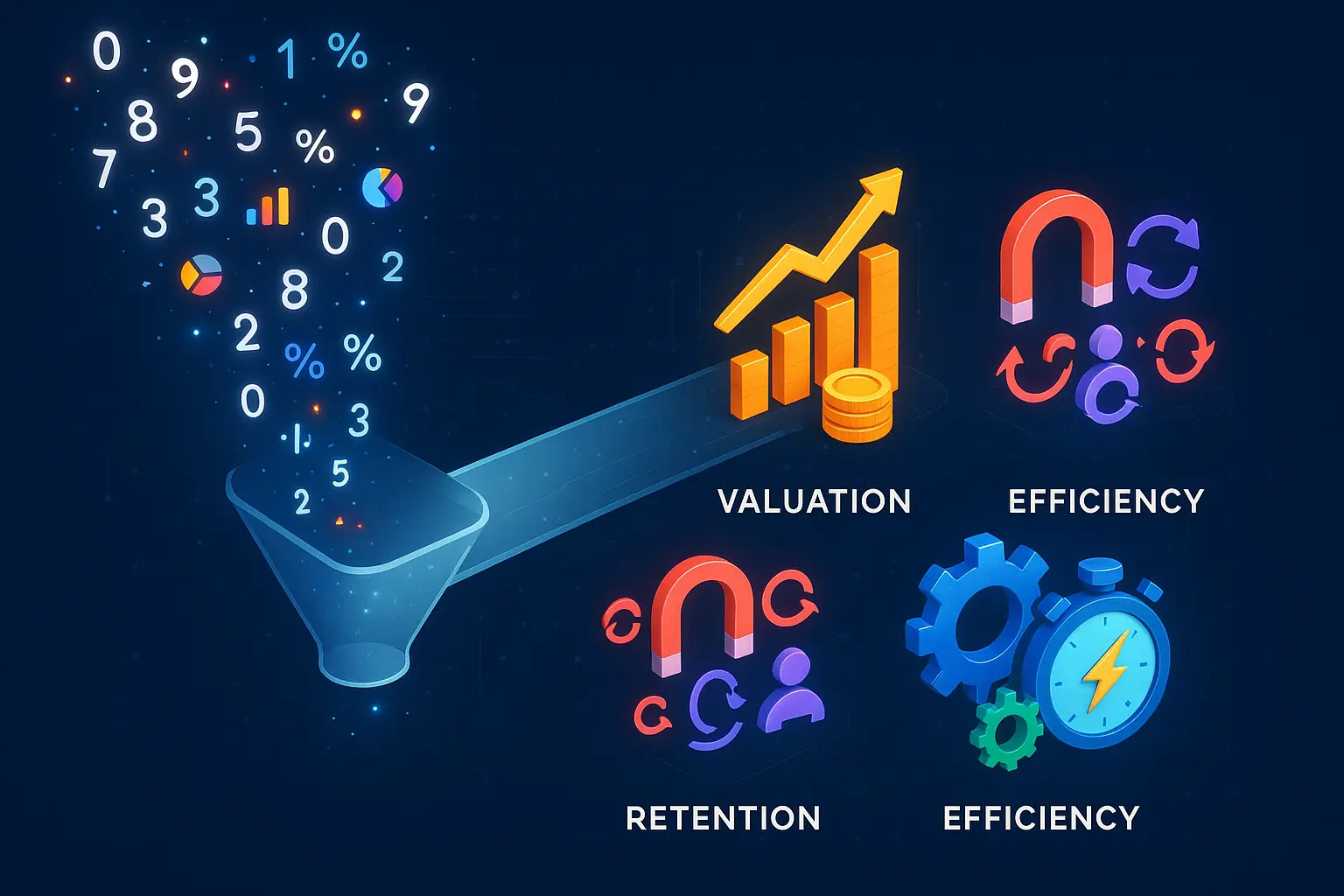
Numbers alone can feel cold — spreadsheets, dashboards, and long query results that never seem to answer the question you actually care about: should we invest, keep this customer, or change the way we make things?
Quantitative analysis is the bridge between that raw data and real business outcomes. It’s not just about plotting trends; it’s about turning those trends into valuation that investors trust, retention strategies that actually work, and efficiency gains that free up time and cash. When you move from “what happened” to “what should we do next,” you stop guessing and start executing with confidence.
In this piece we’ll walk through the practical levers that matter: how finance teams translate models into valuation signals, how product and customer teams use analytics to cut churn and boost upsell, and how operations and R&D squeeze waste out of processes and accelerate time‑to‑value. We’ll also cover the less‑glamorous but essential parts — governance, IP, and privacy — because analysis that can’t be trusted (or sells your data) isn’t analysis at all.
Expect clear examples, simple moves you can test fast, and the measurement techniques that make impact board‑ready. If you want to stop treating data like an archive and start treating it like a growth engine, keep reading.
What the quantitative analysis really means in 2025
Quantitative vs. qualitative: complementary lenses for confident decisions
In 2025, quantitative and qualitative evidence are no longer rival schools — they’re paired instruments in the same orchestra. Quantitative analysis supplies the rigorous, repeatable measurements that expose patterns, seasonality, and causal lever candidates. Qualitative insight supplies context: why customers abandon, what regulators will care about, and which product features truly matter.
Good decision-making stitches both together. Use numbers to narrow hypotheses and set priors; use interviews, field observations, and expert panels to surface constraints, latent needs, and ethical or legal risks. The result is faster, less risky choices: models that point to high‑impact experiments, and human judgment that interprets model outputs where nuance or mission-critical judgment is needed.
Practically, teams should codify this complementarity: quantitative teams run power-calibrated tests and causal analyses; qualitative leads run structured discovery and playbook handoffs; product and commercial leaders translate both into measurable experiments with clear success criteria.
Where it wins today: finance models, life‑sciences R&D, text analytics, imaging, and ops
Some domains have seen game-changing ROI from focused quantitative work: pricing engines that convert segments into higher AOVs, predictive maintenance that shifts spending from firefighting to planned uptime, and imaging pipelines that turn millions of pixels into diagnostic signals. In research-heavy fields, advanced compute and domain models accelerate insight extraction and candidate selection.
“Virtual research assistants can deliver 10x quicker research screening and 300x faster genomic data processing; molecular AI can find drug candidates ~7x faster and improve toxicity prediction (up to ~72% accuracy), dramatically shortening R&D cycle time.” Life Sciences Industry Challenges & AI-Powered Solutions — D-LAB research
Beyond life sciences, text analytics (voice-of-customer, competitor monitoring, intent detection) and structured finance models (scenario stacks, stress testing, and Bayesian updating) are where quantitative methods consistently win commercial outcomes. The common thread is turning diverse, messy signals into repeatable, auditable decision rules that product, sales, and operations can act on.
From descriptive to prescriptive: the stack that moves from data to action
Moving from “what happened?” to “what should we do?” requires a layered stack that connects measurement to execution. At the base are reliable inputs: instrumented events, high‑quality labels, and lineage so you can trace predictions back to data sources. Above that sits feature engineering and model development — built with causal thinking where possible — plus automated validation to prevent silent drift.
The execution layer turns model outputs into business actions: automated pricing updates, prioritized playbooks for customer success, maintenance work-order triggers, or guided research pipelines. Critical glue includes decision logging, experiment frameworks that measure counterfactuals, and human-in-the-loop gates where error costs are high. Monitoring and alerting close the loop so teams detect performance degradation, data shifts, or policy risk early.
Teams that win in 2025 combine three capabilities: strong data hygiene and lineage, disciplined causal experimentation, and robust ops for turning model signals into governed action. That’s how analytics shift from a reporting cost center to a growth engine and a valuation multiplier.
All of this depends on treating trust as a first-class design constraint: models must be explainable enough for auditors and buyers, and pipelines must be auditable for investors. That naturally leads into how you make data decision‑grade — embedding governance, IP protection, and privacy into analytics from day one so your insights can be safely monetized and scaled.
Make your data decision‑grade: governance, IP, and privacy built in
Proving trust: ISO 27002, SOC 2, and NIST 2.0 as analytics enablers (not paperwork)
“IP & Data Protection: frameworks like ISO 27002, SOC 2 and NIST materially de-risk investments — the average cost of a data breach (2023) was $4.24M, GDPR fines can reach 4% of revenue, and adherence to NIST has won contracts (e.g., By Light securing a $59.4M DoD award despite being $3M more expensive).” Portfolio Company Exit Preparation Technologies to Enhance Valuation — D-LAB research
Standards like ISO 27002, SOC 2 and NIST are not compliance theater — they are commercial enablers. Treat them as evidence packages that prove you can protect IP, preserve customer data, and operate at scale. Start by mapping critical assets (models, training data, feature stores, IP repositories), then align controls to the specific risks those assets face: encryption, key management, identity and access controls, logging, and incident response. The outcome is twofold: lower operational risk and higher buyer confidence, which accelerates diligence and can materially affect valuation.
Data contracts, lineage, and secure access to stop silent model drift
Decision‑grade data needs contractual and technical guardrails. Data contracts define expectations—schemas, SLAs, allowed transformations—so downstream models aren’t surprised when producers change. Lineage and versioning let teams trace predictions back to the exact dataset and pipeline version that produced them, which is essential for debugging, audit, and rollbacks.
Combine contracts and lineage with access controls and environment separation: development should use anonymized or synthetic copies, while production models read from locked, monitored stores. Add automated checks at pipeline boundaries (schema validation, distribution shift detectors, label‑quality gates) and model monitors that detect performance drift and trigger retraining or human review before bad decisions propagate.
PII, consent, and minimization: design analytics that pass legal and customer sniff tests
Privacy is a design constraint, not a late-stage checkbox. Apply minimization—only ingest what you need—and document lawful bases and retention policies for each data use. Capture consent and preferences in a single source of truth so user choices flow into downstream labeling, personalization, and marketing systems. For high-risk uses, run DPIAs and keep a record of mitigations.
When possible, use privacy-preserving techniques for development and testing: robust anonymization, differential privacy, and synthetic data reduce exposure while preserving utility. Also ensure vendor risk processes cover subprocessor practices and model‑training exposures, and embed privacy and IP terms into data contracts so rights and permitted uses are clear for buyers and partners.
Built this way, governance and privacy are accelerants: they reduce due‑diligence friction, protect the IP that underpins your models, and make it safe to scale analytics into operations — which is exactly the precondition for harvesting quantifiable revenue and efficiency levers at pace.
Quant levers that move revenue: retention, pricing, and deal velocity
Customer sentiment analytics → +10% NRR, −30% churn, +20% revenue from acting on feedback
“Customer retention levers: GenAI analytics and customer success platforms can reduce churn by ~30% and increase revenue from acting on feedback by ~20%; GenAI call-centre assistants can boost upsell/cross-sell (~15%) and customer satisfaction (~25%).” Portfolio Company Exit Preparation Technologies to Enhance Valuation — D-LAB research
Start by instrumenting the end-to-end customer journey: usage signals, support tickets, NPS/CSAT, and qualitative feedback. Feed those signals into a voice-of-customer layer that produces health scores and prioritized playbooks for retention teams. The commercial upside is concrete: move at-risk cohorts into automated recovery plays, upsell those showing expansion signals, and close the loop by measuring revenue realized from each intervention. Operational targets to aim for are a measurable NRR increase and a material reduction in churn within 90 days of deployment.
Buyer‑intent + AI sales agents → +32% close rates, 40% faster cycles, lighter CAC
Combine external intent signals (third‑party behaviour, content consumption, event attendance) with first‑party engagement to create high-confidence buying signals. Route high-intent prospects to AI sales agents that enrich, qualify, and orchestrate follow-ups so human reps spend time only on deals with confirmed fit. The result is shorter cycles, higher close rates, and lower effective CAC because outreach converts more efficiently and pipeline hygiene improves.
Implement a staged rollout: pilot intent scoring on a top segment, integrate with CRM for automated workflows, then A/B test AI-assisted outreach versus human-only outreach. Track lead-to-opportunity conversion, sales cycle length, and CAC payback to quantify lift.
Dynamic pricing & recommendations → 10–15% revenue lift, higher AOV, 2–5x profit gains
Dynamic pricing and recommendation engines turn product and customer signals into immediate margin and AOV improvements. Use real-time demand signals, customer lifetime value, and competitive context to set offer-level prices or personalized bundles. Recommendation models increase cross-sell conversion at the point of decision, while smart discounting protects margin by targeting price sensitivity rather than across-the-board cuts.
Deploy with guardrails: run closed experiments (canary pricing changes), estimate elasticity per segment, and use uplift modelling to ensure personalization increases incremental revenue rather than simply shifting purchase timing. Tie pricing changes to profitability metrics, not just revenue, so downstream effects (returns, support costs) are captured.
How to prioritise these levers: quick wins are sentiment analytics and targeted churn plays (fast to implement, clear ROI), while buyer-intent pipelines and pricing systems require more engineering but scale higher upside. Combine them: sentiment signals feed recommendation engines, and intent signals inform dynamic offers — a coordinated stack that multiplies impact. Once revenue levers are active and measurable, the same quantitative rigor and experimentation discipline can be applied to operational efficiency to unlock additional margin and scale — and that’s where the analysis shifts from growth to flow, tying revenue gains to sustainable cost-to-serve improvements.
Thank you for reading Diligize’s blog!
Are you looking for strategic advise?
Subscribe to our newsletter!
Quantifying efficiency: from factory floors to workflows
Predictive maintenance math: −50% unplanned downtime, 20–30% longer machine life
Predictive maintenance is an analytics-backed decision process, not a single model. The core is a simple economic equation: estimate the expected cost of failure over a planning horizon, estimate the cost of preventative actions enabled by sensing and models, and invest where preventative cost is lower than expected failure cost. Practically this means instrumenting assets, building signals that correlate with failure modes, and converting alerts into concrete actions (parts ordering, scheduled interventions, or automated shutdowns).
To quantify impact, start with a baseline: measure current unplanned downtime, repair costs, and lost production value. Run a controlled pilot that introduces condition monitoring and a clear remediation workflow; compare realized downtime and service events to the baseline over the same window. Use those observed deltas to model payback and long‑term benefit under different rollout scenarios.
Digital twins and process optimization: 25% faster planning, 30%+ operational efficiency
Digital twins convert reality into an executable model you can experiment on without interrupting production. The twin combines topology, process logic, and live telemetry so you can simulate bottlenecks, test layout or scheduling changes, and evaluate trade-offs across throughput, inventory and quality before committing capital or downtime.
Quantification follows a three-step pattern: (1) validate the twin by reproducing historical outcomes, (2) run counterfactual scenarios to estimate potential gains, and (3) pilot the highest-value scenario and measure actual versus predicted uplift. Capture improvement across operational KPIs that matter to the business — throughput, lead time, first-pass yield, and planning cycle time — and translate those KPI shifts into margin and capacity effects for valuation conversations.
AI agents and co‑pilots: 40–50% task automation, 112–457% ROI, 10x faster research
AI agents and co‑pilots accelerate workflows by automating repetitive tasks, surfacing context, and assisting decisions. The critical measurement is not “tasks automated” alone but the business value per automated task: time saved by skilled staff, reduction in error rates, faster time-to-insight, or scalability of operations without proportional headcount increases.
To measure impact, instrument task flows end‑to‑end. Capture time-per-task and error incidence before deployment, then measure the same after the agent is introduced. Account for the full cost of ownership — development, integration, supervision, and model maintenance — and compute ROI over a reasonable horizon. Monitor qualitative signals too (user adoption, confidence) because trapped resistance often erodes theoretical gains.
How to run pilots that prove (or disprove) value
Design pilots like experiments. Define a clear hypothesis, choose measurable KPIs linked to revenue or cost, select a representative but contained scope, and implement a control or counterfactual. Ensure instrumentation and data lineage are in place before the pilot starts so results are auditable. Run the pilot long enough to capture variability but short enough to iterate quickly. If the pilot meets predefined success criteria, prepare a scaling plan that includes operational handoffs and governance; if it fails, capture root causes and reuse lessons in the next cycle.
Measurement playbook: metrics, cadence, and governance
Adopt a small set of north‑star metrics for each efficiency domain and a set of supporting diagnostic metrics. Track both output metrics (throughput, uptime, cost-to-serve) and input metrics (model precision, false alarm rates, time-to-action). Establish a cadence for review where cross-functional owners interpret causal links between model outputs and business outcomes, and where runbooks and rollback plans are agreed in advance.
Governance is particularly important: define ownership for data quality, model performance, and remediation processes. Embed automated alerts for performance drift and link them to incident workflows so teams can correct model or data issues before they translate into business losses.
Common pitfalls and how to avoid them
Measurement fails when teams optimize narrow signals that don’t reflect full business cost, when pilots lack proper controls, or when human change management is ignored. Avoid these traps by mapping every model decision to a financial impact pathway, keeping experiments statistically defensible, and investing in training and incentives so operators adopt recommended actions.
When these methods are applied together — condition-based maintenance to protect uptime, digital twins to optimise process design, and AI agents to streamline human workflows — the result is a step-change in operating leverage. The final step is to demonstrate causality and persistence of gains, which naturally leads into how to design experiments and causal models that board members and acquirers will trust.
Proving impact: experiments, causal models, and board‑ready reporting
North‑star metrics and guardrails: tie models to revenue, margin, risk, and time‑to‑value
Select a single north‑star that captures the primary business outcome you want the model to move — for example a revenue, margin, retention or throughput metric — then map every model and experiment to that north‑star through a short chain of causality. For each link in the chain define supporting diagnostics (leading indicators) so teams can tell whether the intervention is behaving as expected before the north‑star moves.
Pair targets with guardrails that protect value and brand: error thresholds, fairness constraints, maximum allowable negative impact on key customer segments, and time‑to‑rollback. Treat guardrails as budgeted risk — if an experiment exceeds a guardrail, an automated or human review is triggered and the change is paused until mitigations are in place.
A/B, diff‑in‑diff, and power: ship experiments that survive scrutiny
Design experiments with the same rigor you would a financial model. State a precise hypothesis and the exact metric you will use to accept or reject it. Where randomization is possible, use A/B tests with pre‑registered analysis plans and pre‑defined stopping rules. When randomization is infeasible, use quasi‑experimental designs such as difference‑in‑differences, regression discontinuity, or matched cohorts — but be explicit about assumptions and run balance and placebo checks.
Make statistical power and sample size calculations mandatory for any experiment that will influence material investment decisions. Control for multiple comparisons, report confidence intervals and effect sizes (not just p‑values), and surface sensitivity tests that show how conclusions change under different assumptions. Finally, bake experiment infrastructure into the product lifecycle so experiments are reproducible, logged, and auditable.
From dashboards to decisions: cadence, counterfactuals, and pre‑mortems for models
Turn analytics into board‑ready narratives by focusing on three things: a concise topline (what changed and why), the counterfactual (what would have happened without our work), and the confidence and risks around the claim. Dashboards should show the topline trend, the experiment or attribution method used, variance and confidence bounds, and the key supporting diagnostics that validate the causal link.
Institutionalize a regular cadence where cross‑functional owners review model performance and experiment outcomes, escalate anomalies, and update decision timelines. Complement that cadence with pre‑mortems before major model launches to surface failure modes, and post‑mortems when outcomes diverge from expectations to capture lessons learned and corrective actions.
When you package results for boards or acquirers, lead with the business impact and the ask (scale, pause, or invest), present the counterfactual and uncertainty clearly, and document the operational requirements to sustain gains — monitoring, retraining cadence, data contracts, and clear ownership. That combination of causal evidence, transparent uncertainty, and operational readiness is what turns analytics from interesting dashboards into defensible value creation.